Why Every AI Startup Sounds the Same (and Why This Is Bad News for Startups)
And the three ways startups can achieve commercial success and growth.

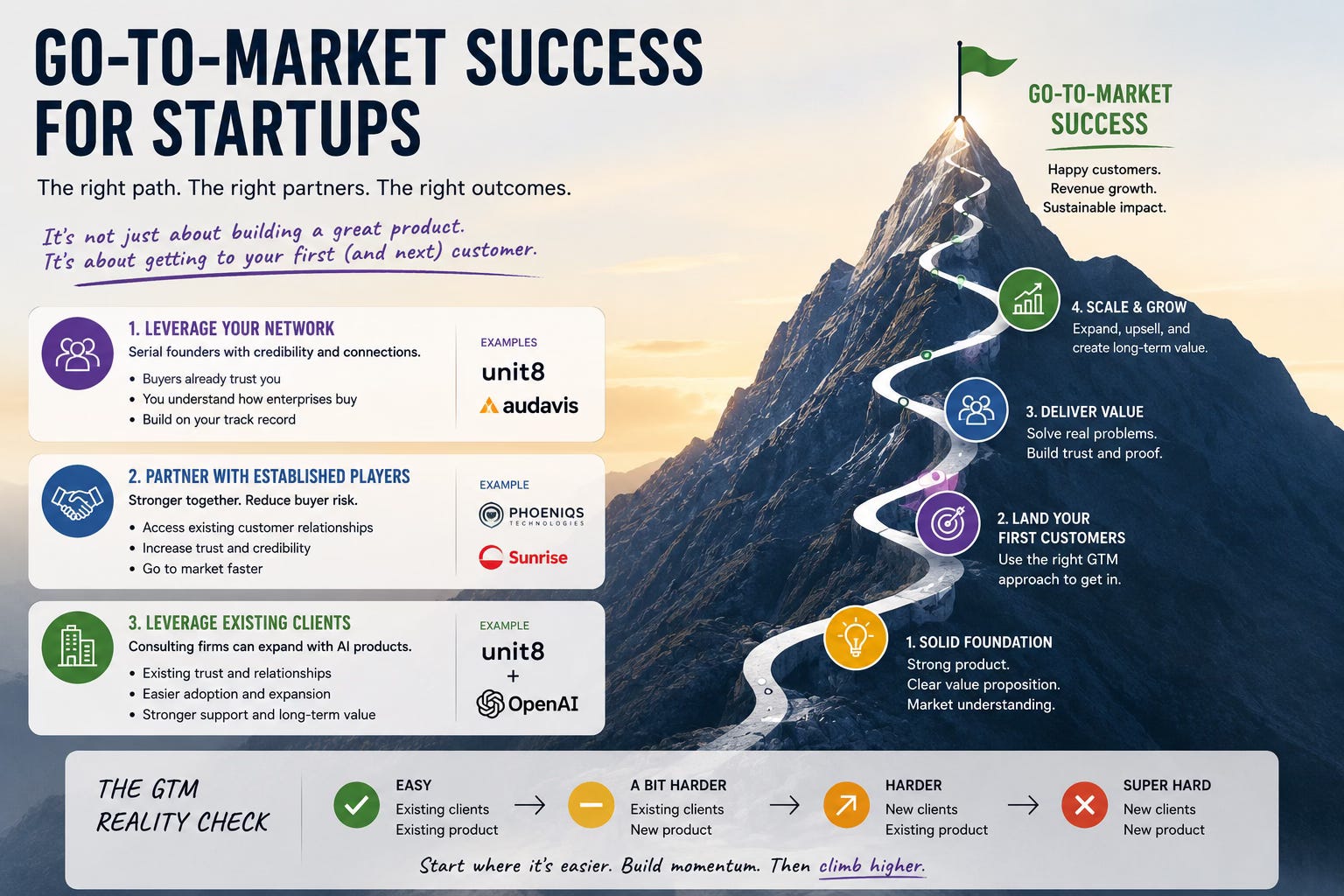
Drowning in AI Slop
Every day, I receive a flood of AI startup pitches. Most of them look super polished. They come with beautiful decks, carefully written mission statements, impressive product claims, and LinkedIn posts announcing the next “major breakthrough” in AI.
And yet, almost all of them feel exactly the same.
That’s because a lot of it is AI-generated.
Ironically, in the rush to build AI companies, many startups are outsourcing their entire voice to AI. The result is that the content sounds professional on the surface but lacks personality, conviction, and real-world experience underneath. You can feel it immediately as a reader.
And honestly? It creates the opposite effect founders want. Instead of building trust, it makes companies feel generic and interchangeable. Buyers and investors start to wonder whether the startup has genuine competence and capabilities or is merely AI-engineering content.
If every startup sounds the same, how do you know who actually understands the problem they’re trying to solve?
I think authentic, human communication is about to become much more valuable than people realize. It will also support a successful go-to-market if content comes from your mouth.
The Buyer Problem Nobody Talks About
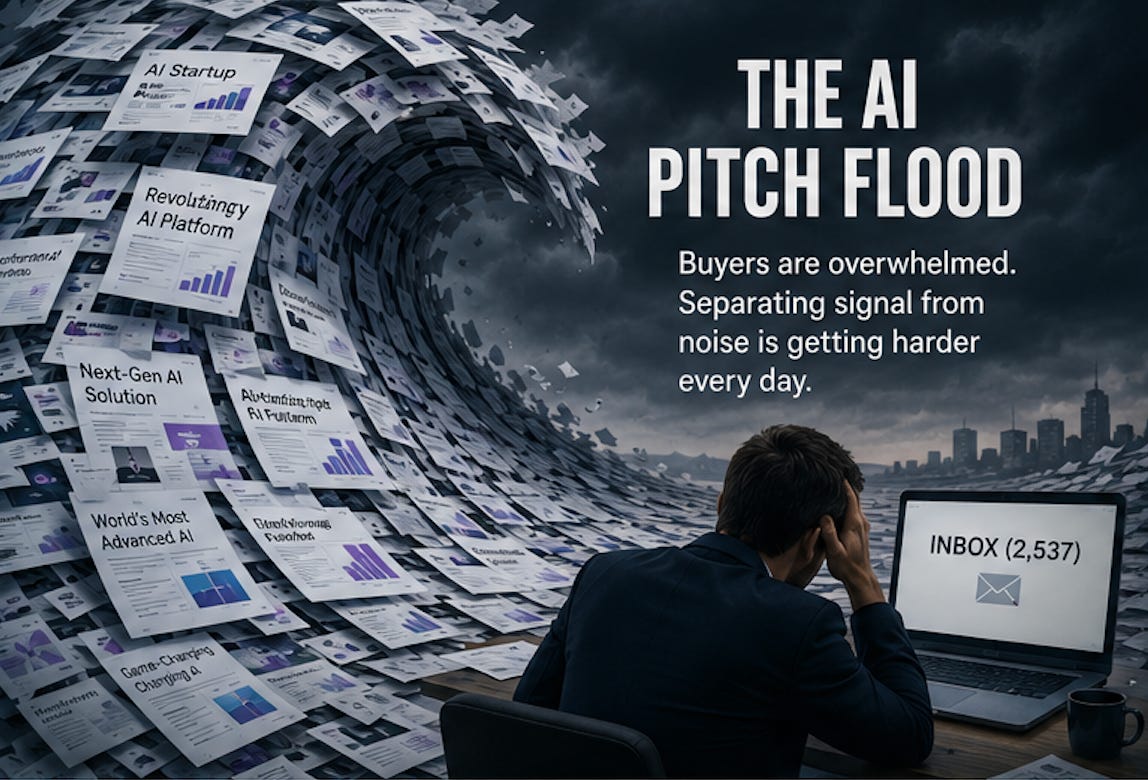
Recently, I’ve had several conversations with banks and insurance companies exploring AI solutions. Almost all of them are overwhelmed with AI.
They’re getting approached by startups, consultants, software vendors, and large US AI companies; all promising transformational results. Everyone claims they can improve productivity, reduce costs, automate workflows, or unlock hidden value from data.
The pitches are polished. The promises are huge.
But buyers are struggling to separate signal from noise.
At the same time, many large companies are debating whether to build AI internally rather than buy external solutions. Some are experimenting with in-house AI teams, while others are trying to figure out how much AI they can realistically own themselves.
This makes it hellishly hard for early-stage startups to pitch their solutions to large corporations.
Even though my view is that only the largest organizations will be able to build serious long-term AI capabilities internally. AI is moving too quickly, requires too much capital, and changes too fast for most companies to keep up on their own.
So the real question for startups becomes: How do you actually win clients in this environment?
What Actually Works in AI Go-To-Market
Over the past months, I’ve spoken with both Swiss companies buying AI solutions and US AI startups that have raised enormous amounts of funding. The contrast is striking.
In Switzerland, many startups are still heavily product-focused. Founders spend enormous energy perfecting the technology, optimizing models, and refining features. Sales and go-to-market often come later.
In the US, it’s usually the opposite. Many successful startups are obsessed with distribution and commercial execution from day one.
They often combine technical founders with highly commercial founders who know how to sell into large organizations. And that difference matters.
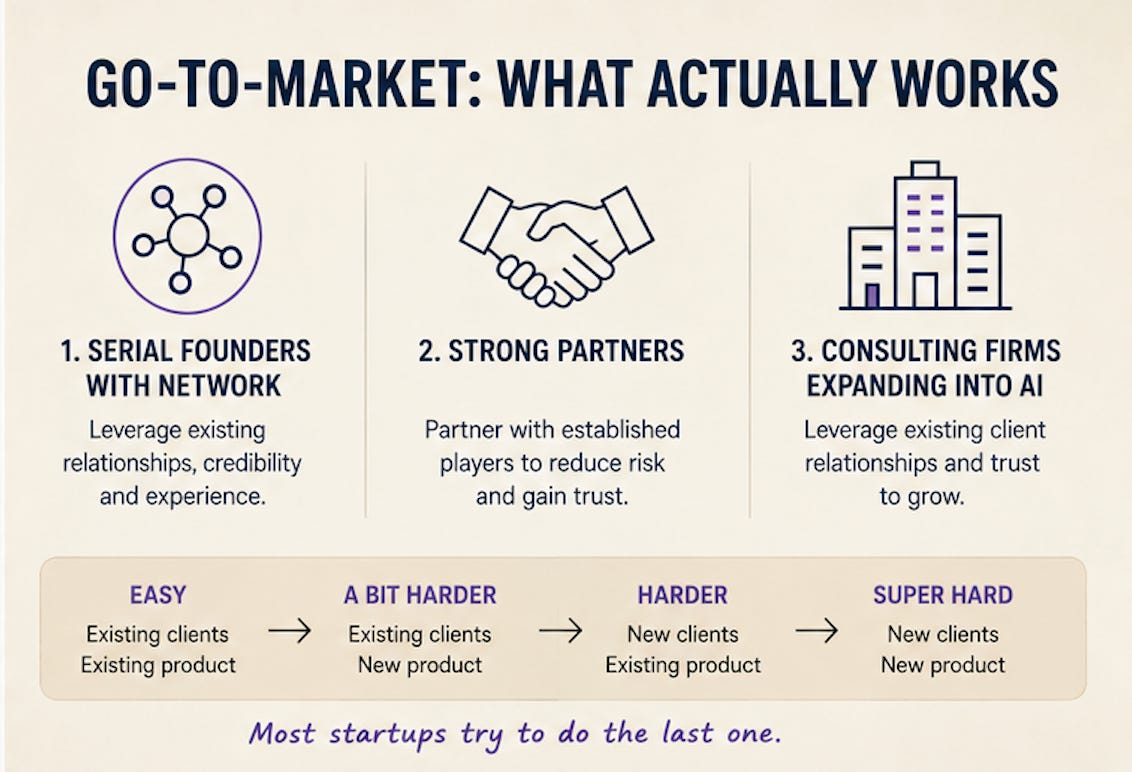
From what I’ve seen, there are three go-to-market approaches that consistently work well in Switzerland.
A) Serial Founders with Existing Networks
The easier path is when founders already have credibility, relationships, and investors behind them. Serial entrepreneurs understand how corporations buy technology. They know how procurement works, how enterprise sales cycles work, and how to navigate large organizations. Most importantly, buyers already trust them.
Companies like Unique.ai are good examples of this approach with serial founders leveraging their expertise and network to grow internationally.
B) Startups That Partner with Established Players
Another successful strategy is partnering with companies that already have strong customer relationships. This lowers perceived risk for buyers. Large companies are naturally cautious when working with small startups. They worry about long-term support, data privacy, security, compliance, and whether the startup will even survive long enough to maintain the product.
Strong partners help remove that fear. A good example is Phoeniqs Technologies partnering with Sunrise.
C) Consulting Companies Expanding into AI Products
The third model I see working well is for existing consulting or technology firms to offer AI products to their current clients. This is powerful because trust already exists. Clients already know the company, understand their capabilities, and feel more comfortable buying additional AI services from someone they already work with.
Again, Unit8 is a strong example here through their AI partnerships and enterprise relationships. Unit8 gives OpenAI access to the Swiss market, with OpenAI providing cutting-edge technology.
Selling from Easy to Hard
At the end of the day, this all comes down to a very simple business truth about selling:
Easy: selling an existing product to existing clients
Harder: selling a new product to existing clients
Even harder: selling an existing product to new clients
Extremely hard: selling a new product to new clients
Many AI startups today are trying to do the last one. This is the true startup hustle, and it is devilishly hard. It is a pure hustle.
You have to rely on your network, make introductions one by one, and slowly build trust over time. It’s difficult, time-consuming, and risky.
But for many Swiss founders, it’s the only path available.
Remember: Buyers are Risk-First
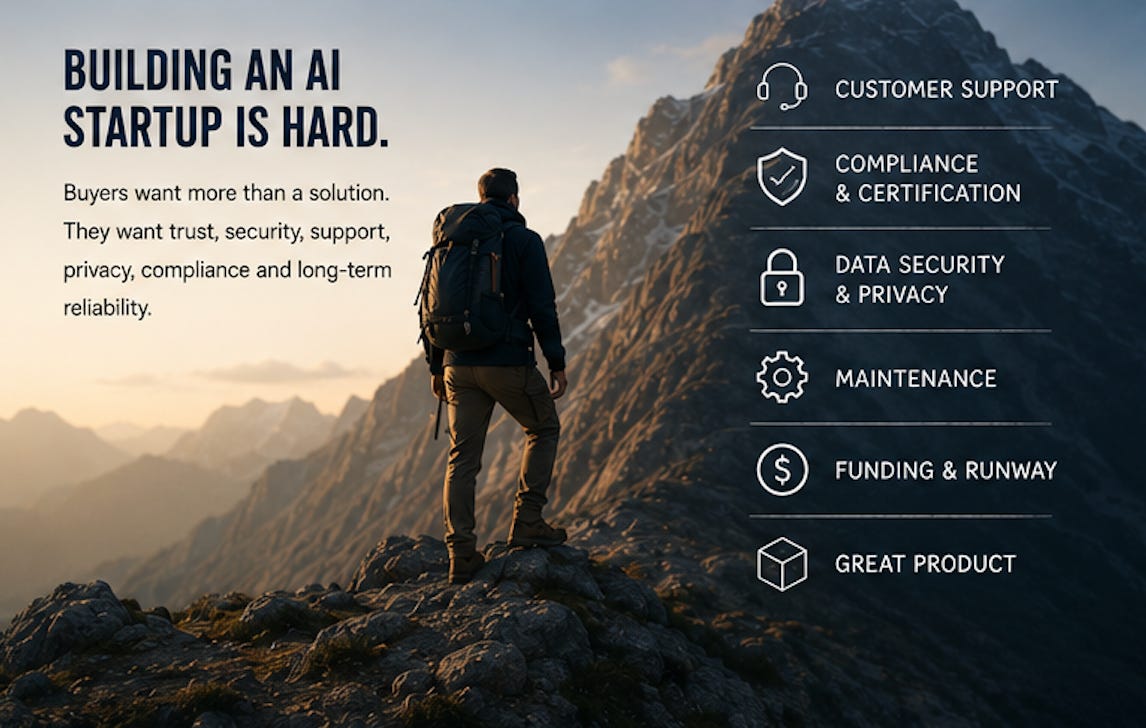
One thing founders often underestimate is that buyers are not just purchasing a product. They are purchasing reliability. Buyers care about support, maintenance, compliance, certifications, data privacy, and long-term stability.
These are difficult things for early-stage startups to provide.
In the US, ecosystems like Y Combinator help bridge this gap. Their networks create trust, early customers, and momentum for startups long before products are fully mature.
Switzerland still lacks a large-scale startup support ecosystem, especially for later-stage AI funding.
And that is a big handicap, which is why many Swiss founders often sell to US investors.
As US startups can raise tens or even hundreds of millions of dollars, giving them time to experiment, pivot, and survive mistakes. Swiss startups rarely have that luxury.
Reality-Check Needed?
AI will continue to flood the market with content, products, pitches, and noise.
But trust is becoming more important, not less.
The companies that stand out won’t necessarily be the loudest or the most polished. They’ll be the ones that feel real. They can show true traction and competence.
You have made it this far in my post; you must be seriously interested in how to grow your startup successfully. Congratulations!
For many years, I have been working with US and European founders on their go-to-market strategy.
If you want a quick assessment (for free) of where you stand, feel free to email me!
And please — no AI slop!
(Note: The above text was written by me and polished by AI. The images are AI slop.)